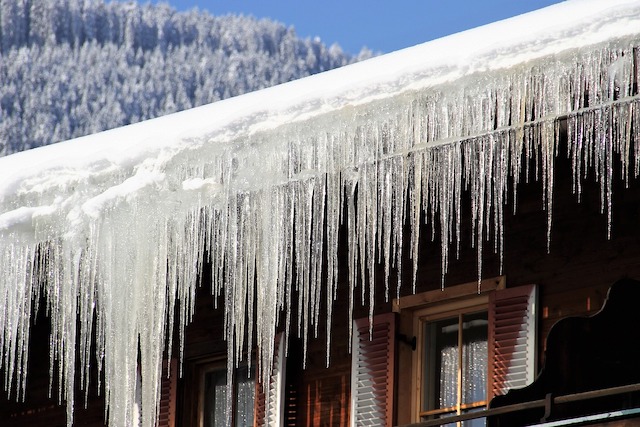
Ice dams form when warm air from your home melts snow on your roof, and that water refreezes at the colder roof edge, usually inside your gutters. In Edmonton, this happens a lot because of long winters and constant freeze-thaw cycles.
The real problem isn’t just the ice you can see—it’s the water you can’t see. That trapped water can back up under shingles, overflow gutters, damage fascia boards, and eventually lead to leaks inside your home.
What’s Actually Going On Up There
You don’t really notice an ice dam forming. Most people only see it once there’s a row of thick ice sitting in the gutter or hanging off the edge of the roof. By that point, it’s already been there for a while.
What’s happening starts inside the house. Warm air leaks into the attic — usually through small gaps you’d never think about — and that heat warms the underside of the roof. Snow on top of the roof starts melting from underneath, not from the sun.
That water runs down until it hits the cold edge of the roof and freezes again. Day after day, it builds up in layers. Eventually you’ve got a solid ridge of ice sitting right where water is supposed to leave the roof.
And once that ridge is there, everything behind it backs up. Water doesn’t stop moving just because it’s cold. It just changes direction — and that’s where the trouble starts.
Why Edmonton Gets Hit So Hard With This
If you’ve lived here long enough, you already know the weather doesn’t sit still. One week it’s deep cold, the next week you’re above freezing during the day, then back below freezing at night. That back-and-forth is exactly what feeds ice dams.
Every small warm-up melts a bit of snow. Every cold snap locks it back in place. The roof never really gets a chance to clear itself properly, so the cycle just keeps stacking on top of itself.
Throw in a heavy snowfall year and you’ve got more insulation sitting on the roof trapping even more heat inside the structure. It’s not one big problem — it’s a bunch of small ones lining up at the same time.
What Homeowners Usually Notice First
Most people don’t realize it’s an ice dam until something forces their attention.
Sometimes it’s big icicles hanging off the front of the house. Sometimes it’s water stains that show up inside near the top of a wall or ceiling. Other times it’s just gutters packed solid with ice when everything else looks fine.
By the time you can see it clearly from the ground, it’s already been doing its thing for a while up on the roof.
Where the Real Problem Actually Starts
This is the part a lot of people miss. The ice you see at the edge of the roof isn’t the real issue — it’s the result of something else going on above it.
In most homes, it comes down to heat loss. Attics that aren’t sealed properly, insulation that’s uneven or thin in spots, or warm air leaking from the house into the roof space. That heat doesn’t seem like much, but over a long winter it’s enough to start melting snow from underneath.
So people often end up looking at gutters or blaming drainage, when in reality the roof is basically being warmed from the inside out.
What Ice Dams Do Over Time
Once that ice ridge forms, water starts backing up behind it. That water will always look for a path, and roofs aren’t designed to hold standing water.
It can work its way under shingles, soak into the roof decking, and in some cases end up inside the house. That’s when people start noticing ceiling stains or damp drywall and think they’ve got a sudden leak — but the process usually started weeks earlier.
On the outside, gutters take a beating too. Ice is heavy. It pulls on fasteners, bends sections, and in some cases tears parts of the system away from the fascia. Even if nothing breaks immediately, repeated freeze-thaw cycles slowly weaken everything holding it in place.
A Real Situation From Edmonton
Had a call from a homeowner in the north side of Edmonton who thought their roof was leaking. Water stains upstairs every winter, same spot.
Got up there and the roof wasn’t the problem in the way they expected. There was a thick ice dam running the entire front edge of the house. Gutters were frozen solid and water had been backing up under the shingles for a while.
Once we looked inside the attic, it was pretty clear what was going on. Warm air was getting into the roof space through a few weak points, and insulation wasn’t consistent across the whole area.
Fixing the ice alone wouldn’t have solved anything. It would’ve just come back next winter. The real fix was dealing with the heat loss so the roof could stay cold like it’s supposed to.
What It Usually Costs to Deal With
If you catch it early, it’s not usually a major expense. Ice removal or mitigation can be a few hundred dollars depending on the size of the home and how bad it is.
If gutters get damaged or pulled out of alignment, you’re usually into repair territory in the hundreds to low thousands. Once water gets inside the house, though, that’s where costs start climbing depending on how long it’s been going on.
Final Thought
Ice dams aren’t really a gutter problem. They show up at the gutter, but they usually start somewhere else entirely.
In Edmonton, they’re just part of living in a climate that swings back and forth all winter. But they’re not something you just ignore either. Because once water starts backing up under your roof, it doesn’t take long before it becomes more than just an exterior issue.
The goal is simple — keep the roof cold, keep water moving, and don’t give ice a place to build up in the first place.
Not sure what your gutters need?
Book a free inspection and we'll tell you straight, no upsell.
Get a Free Inspection